

GPS and activity
GPS Records for Guard and Patrol Shifts
Review reported location alongside the shift’s observations and evidence. JUDGR provides latest-position context, retained trails, and tracking recovery information with timestamps for interpretation.
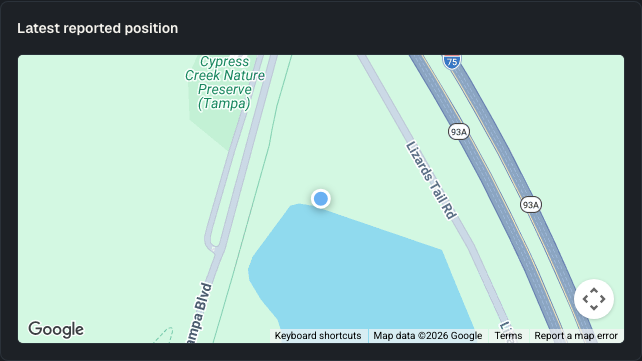
A reported sample has a time and a limit
The latest position is the newest sample received from the device. Check capture time, accuracy, and freshness when using it. Delayed delivery can leave a reviewer looking at an older reading; the display is not guaranteed continuous tracking.
Understand the boundary used for the shift
Sites use a circle or drawn outline. A start requires acceptable fresh location inside the configured boundary, including its edge. Active and historical shifts retain the boundary selected at start.
For drawn sites, the outline remains the actual boundary. A larger device monitoring circle helps request readings without changing start eligibility.
Inspect tracking rather than assume it
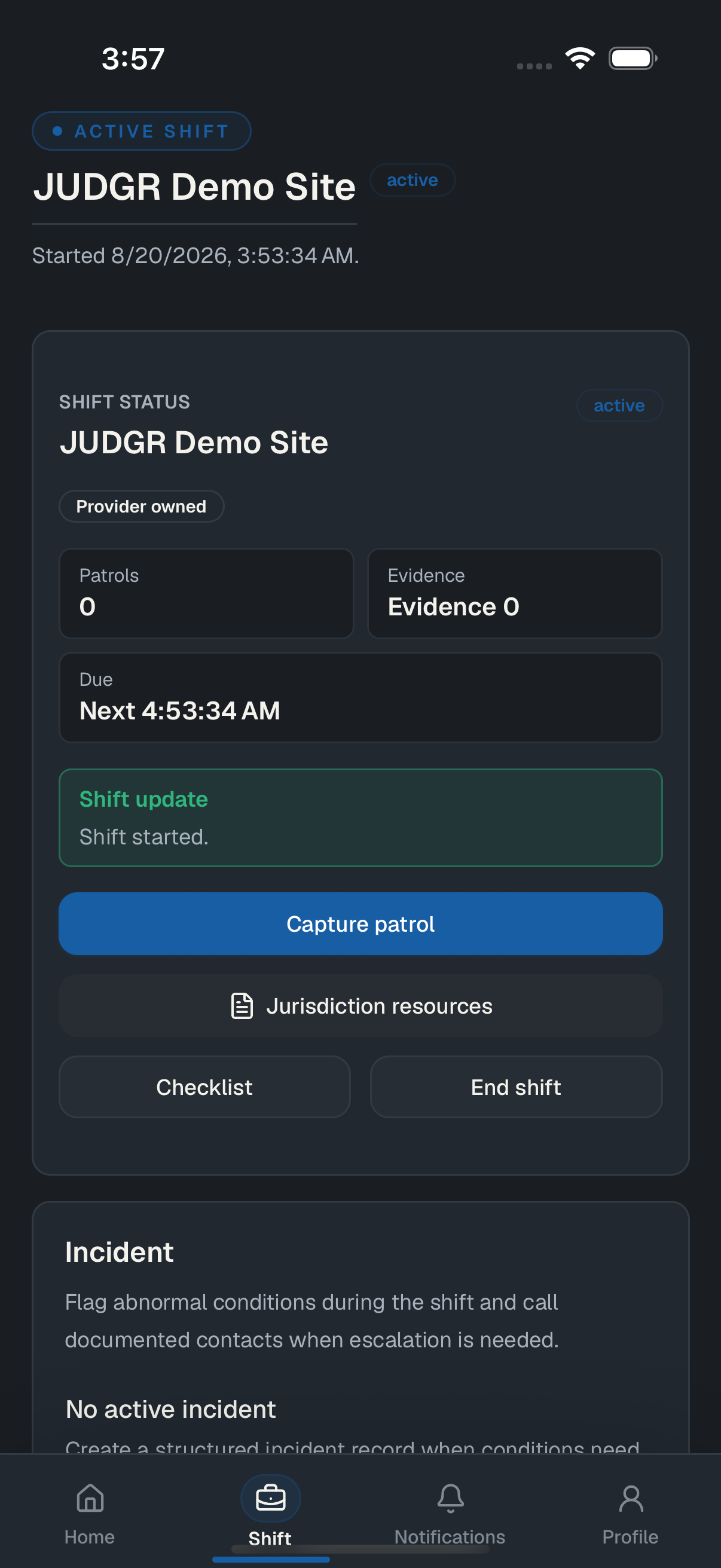
Active tracking depends on location and motion access, device support, and operating-system conditions. Tracking & sync details shows paused, interrupted, or limited collection. Last GPS sample and Last activity sample help confirm whether readings are arriving.
Use the recovery path for the actual problem
Inspect device settings for required permissions, then return to the app and use Retry tracking where offered. Network access and permissions solve different problems. Retain pending readings while recovering; resumed collection cannot recreate unrecorded samples.
Separate collection from synchronization
After an online start, supported readings can queue through disconnection. Reviewers see server-received samples, so they may see an older position while the device retains later readings. Reconnect and inspect synchronization before treating the record as current.
Use the completed trail with other evidence
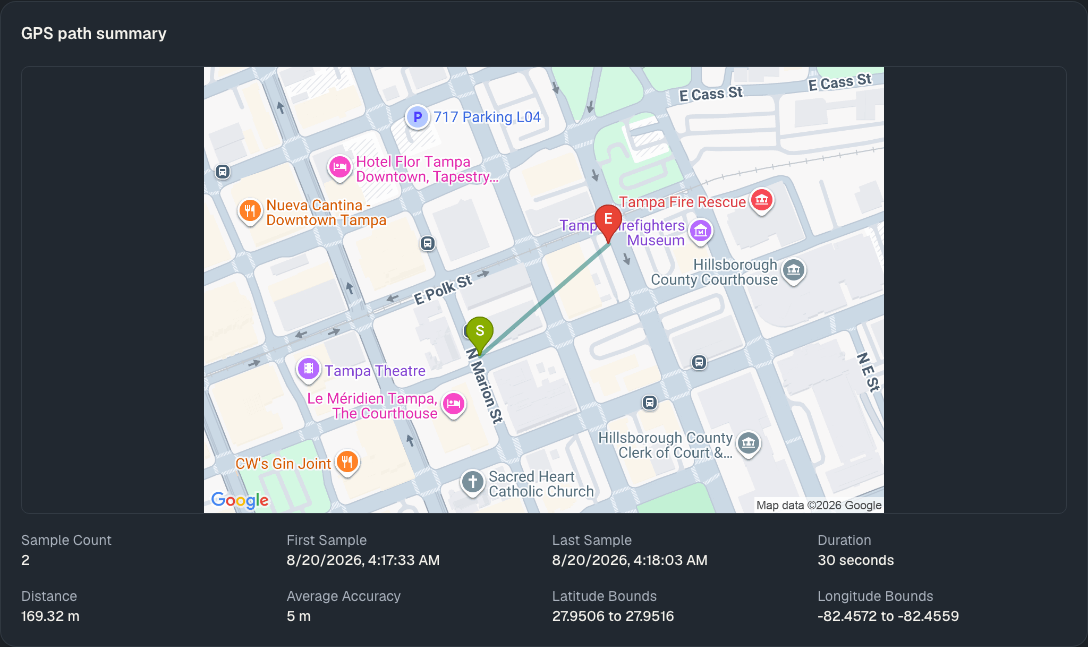
Completed records retain available route information with patrols, notes, incidents, and evidence. Read those sources together. A point near an entrance shows reported location; the patrol observation explains what was checked. Missing samples remain uncertainty to investigate.
Keep location access tied to legitimate review
Provider and AHJ location review follows authorized organization and site relationships. Public report verification checks authenticity while keeping private GPS and evidence protected. Agree the recipient’s review needs through the operating organization.
Questions about gps and activity
Is the live map a continuous tracker?
No. It displays reported samples; device conditions, permissions, and connectivity affect capture and delivery.
Can missing samples be recreated after reconnecting?
Recorded samples can synchronize later. Readings never collected cannot be reconstructed by retrying.
Does a new patrol entry guarantee a new GPS point?
No. Patrol submission and location collection have separate timing. Check both timestamps.
Does public verification show the patrol route?
No. Public authenticity checks keep GPS history and private evidence protected.
Keep exploring
Next step
Connect your field work and review
Tell us about your team, sites and reporting needs. Explore JUDGR or discuss your workflow with us.